No disclosure for 5 years? How does $41,000 in retroactive arrears sound!
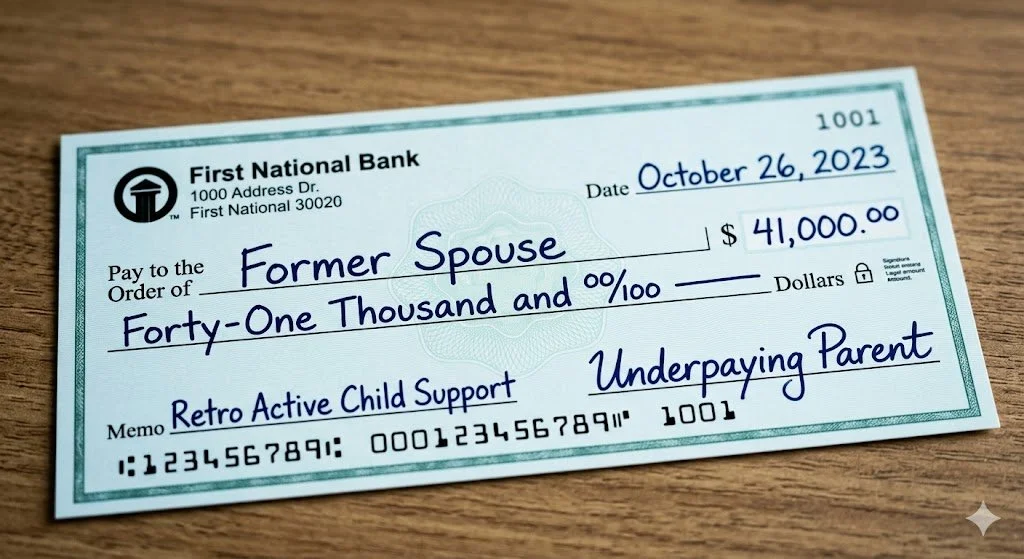
Non-disclosure risks a huge lump sum retroactive child support award
If you pay child support in British Columbia, here is the question that should keep you up at night. When was the last time you sent your former partner your tax return?
A new BC Supreme Court decision, Ketterer v. Altena, released on May 28, 2026, shows exactly what happens when the answer is "never." A father who diligently paid $435 per month for years was hit with over $41,000 in retroactive child support. The reason is one of the most important principles in family law, and it is one that many separated parents quietly ignore.
The Story
The parties lived together from 2005 to 2011. They never married. They had two boys. In 2012, they went to mediation. Both had lawyers. They reached a settlement. The father would pay child support of $435 per month based on his reported income of $50,000 per year. The mother's income was imputed at $20,000. The parties agreed to a 4-day-on, 4-day-off shared parenting schedule. And critically, they agreed to exchange financial disclosure every year.
The father started paying $435 per month in December 2012. He kept paying $435 per month for over a decade. He never increased it. He never disclosed his rising income.
His Line 15000 income tells the real story. In 2014 it was $46,000. By 2017 it was $88,000. By 2022 it was $90,000. He was earning nearly double what he had at mediation. And the mother received the same $435 every month.
Then it got worse. In February 2024, the father unilaterally reduced his payment to $198 per month. He told no one why he made that decision. He simply did it. He claimed the older boy was now an adult — except the boy was still 17 at the time. Then in August 2025, the father stopped paying entirely.
The Court's Response: This Is Blameworthy Conduct
When the mother finally got a lawyer in February 2025, things moved quickly. Her counsel demanded disclosure. The father's lawyer ignored the demand. The mother filed an application. The court ordered disclosure. The father missed the deadline. The mother filed another application asking for a fine. The father suddenly produced his disclosure.
When Justice Hardwick finally got the full picture, she was unimpressed. She cited a famous line from another BC Supreme Court decision: "failure to disclose material information is the cancer of family law litigation."
The general rule from the Supreme Court of Canada is that retroactive child support can usually only reach back three years before formal notice. But when a payor parent has engaged in blameworthy conduct, that limit does not apply. The court can reach further back to the point when the income actually changed.
Justice Hardwick exercised that power. She set the retroactive award back to January 2021. That is roughly 49 months before formal notice, well past the three-year default. The judge calculated child support year by year, using the actual incomes, and arrived at $41,457 in arrears.
The Self-Help Problem
The father's biggest mistake was not just the non-disclosure. It was the unilateral reduction. By choosing to drop his payment to $198 in February 2024, he proved he understood that child support is variable. He understood that income matters. He knew the number was negotiable. He just refused to share information that would have caused the number to go up.
Judges hate this. Child support is the right of the child. It is not a bargaining chip. It is not something a payor parent can quietly adjust based on personal grievances or estimates. As Justice Hardwick put it, it does not accord with the law to reward payors who use "self-help remedies" to avoid their obligations.
The Henry Exception
There is one other piece of this decision worth flagging. By the time the mother filed her application, the older son had turned 19 and was no longer a "child" under the Family Law Act. The father argued the court had no jurisdiction to award retroactive support for the older son.
The court disagreed. There is something called the Henry exception, which says that if a process for compelling disclosure was started while the child was still a child, the court keeps the power to make a retroactive order even after the child ages out. The mother's earlier application in 2013, and the disclosure order made by the court at that time, were enough to keep the door open.
This is a quiet but important point. If you have an older teenage child and you suspect your former partner has been underpaying for years, the clock is not necessarily up the moment your child turns 19. The right legal steps, taken at the right time, can preserve your child's right to support that should already have been paid.
Three Lessons If You Are Receiving Support
First, the annual exchange of financial disclosure is not optional. If your separation agreement or court order says you exchange returns every July, follow it. If your former partner stops, demand the disclosure in writing. That single act preserves your right to come back later for an adjustment.
Second, if you suspect your former partner's income has gone up significantly and no adjustment has been made, get advice. The three-year default looks like a barrier, but blameworthy non-disclosure can move that line back substantially.
Third, do not assume your child aging out closes the door. The Henry exception is real. Speak to a family lawyer before time runs out.
Three Lessons If You Are Paying Support
First, never unilaterally reduce or stop paying support. If your income has dropped or your child's circumstances have changed, apply to the court or negotiate a written agreement. The judge in Ketterer treated the unilateral reduction as proof that the father knew the law and chose to ignore it. That is the worst possible look in a courtroom.
Second, disclose. If your income has gone up materially and you have stayed silent, you are accumulating risk. You are not building certainty. You are building a retroactive award.
Third, if you genuinely cannot pay, that is a real argument. But you need to make it properly, with evidence, in front of a judge. The father in Ketterer claimed health hardship, but the court called his evidence "woefully inadequate." A real hardship claim has real medical and financial documentation behind it.
The Bigger Picture
Ketterer is not an unusual case. It is reminiscent of our office’s big win in L.A.B. v. M.L.B.2025 BSCS 2160. It is the kind of file that walks through family law offices in BC every week. A separated parent quietly pays the old number for years, never updates, and eventually finds out the cost.
If you are reading this and any of it feels familiar, the worst thing you can do is keep doing nothing. The best thing you can do is get a clear picture of where you actually stand.
At Recovery Family Law, we work with parents on both sides of child support every week. We can tell you in one consultation what your real exposure or entitlement looks like. Get in touch. Your first consultation is free of charge and free of obligation.