New Family, New Debt, Same Support Bill? Not Quite.
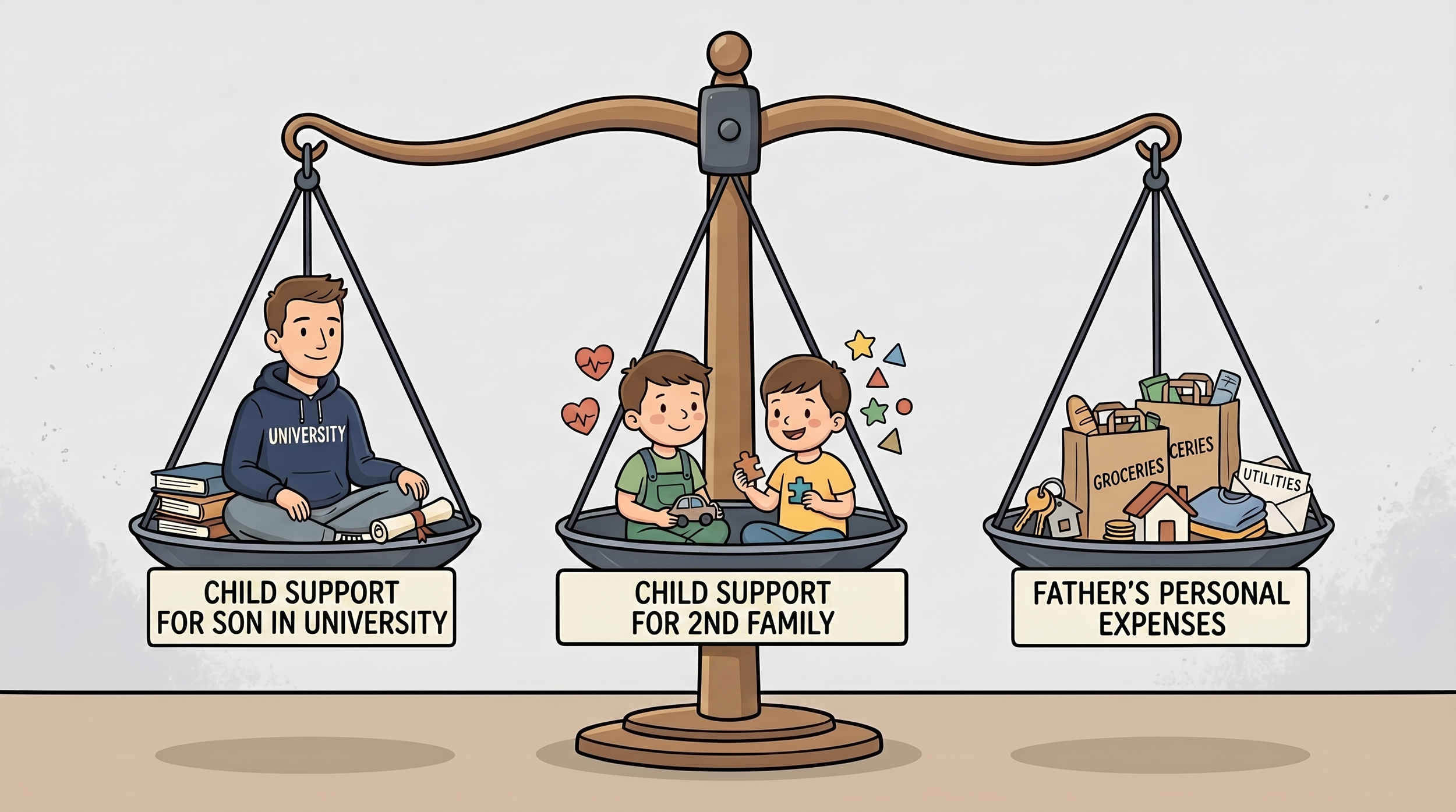
Schmidt v. Schmidt looks at how the court balances all the obligations.
Picture this, you are paying child support for your adult child who is attending university. Then, for reasons you may regret at 2am in the morning while the infants wont sleep, you start a new family. Your new family includes two young children with special needs, a mountain of debt, and a home you might lose. Money is tight in every direction. Can you ask the court to lower or cancel the support you pay for your older child?
In Schmidt v. Schmidt, 2026 BCSC 1004, the court looks at this very scenario. The answer is nuanced, and it reveals how judges balance competing family obligations. So lets review it shall we.
The parents divorced in 2017. Their one child is now 21 years old and a full-time university student. A 2020 consent order set child support at $700 per month. The father later re-partnered and had two additional children, both with diagnosed special needs. Then that second relationship ended as well. The father accumulated large debts, fell behind on his mortgage, and faced genuine financial trouble.
The father asked the court to do one of two things: 1) either cancel his support for the older child, or 2) assess it under a "means and needs" test instead of the table amount.
He relied on two provisions of the Federal Child Support Guidelines. The first was the undue hardship rule. The second was a special rule that applies specifically to adult children.
Let's begin with undue hardship. This sounds like a promising argument when money is tight. But the threshold is genuinely high. The law requires the hardship to be severe, extreme, or unreasonable. It is not enough to simply have a tight budget or a second family, because many people have exactly those pressures.
The judge examined the numbers carefully. The father's support for his older child was $700 monthly. That represented only about six percent of his yearly expenses. The court pointed out that the real problem was not the child support at all. The real problem was the heavy debt from his second relationship. The judge said it was time for the father to address that debt, perhaps through a consumer proposal. The support for his older child should be the last obligation to give way, not the first.
There was another complication. The substantial debts were incurred after he separated from his first wife. The hardship rule primarily considers debts tied to the family the support obligation is for. So those newer debts did not fit the rule particularly well.
The result? The undue hardship argument fails.
The judge then turned to the adult child rule. When a child is over 19 but still depends on a parent, the court has a choice. It can apply the ordinary table amount or apply a "means and needs" test. The “means and needs test examines what the child actually requires and what each parent can realistically afford.
The facts had shifted since the previous consent order. The adult child still lived at home, but he now earned roughly $27,000 annually from part-time work. He paid a modest rent to his mother. He had even taken out a student loan to cover his own tuition. In short, he was carrying considerably more of his own weight.
The judge decided the means and needs test now fit the situation better. The child still needed help, but less than before. The father was also in genuine financial distress. So the court reduced the support by half, from $700 to $350 per month.
This case teaches several key lessons.
First, undue hardship is a difficult argument to win. Having a tight budget is simply not enough. Courts set the threshold high deliberately.
Second, support for adult children can change as their circumstances change. When a young adult begins earning real income, that can be a fair reason to revisit the amount.
Third, evidence is everything. This case had a messy paper trail. Neither parent filed a clean, current financial statement. The judge said the file offered little room for optimism that better evidence was coming. So the court made what it called a "rough and ready" ruling. If you want a precise result, you need clear, current, appropriate financial documents. Vague or stale paperwork can genuinely cost you.
Fourth, your obligations to your various children do not simply cancel each other out. The father here argued that his two younger children should displace the older one. The court did not accept that reasoning. Each child possesses an independent right to support.
If one spouse’s income has dropped or your family situation has changed substantially, there may be grounds to adjust support. Whether you are seeking to keep the support flowing or limits what is being paid, building the right case is essential. Strong evidence wins, and weak evidence loses. So contact one of our team at Recovery Family Law and we will help you get sorted out.