Why an Old Prenup, needs updating
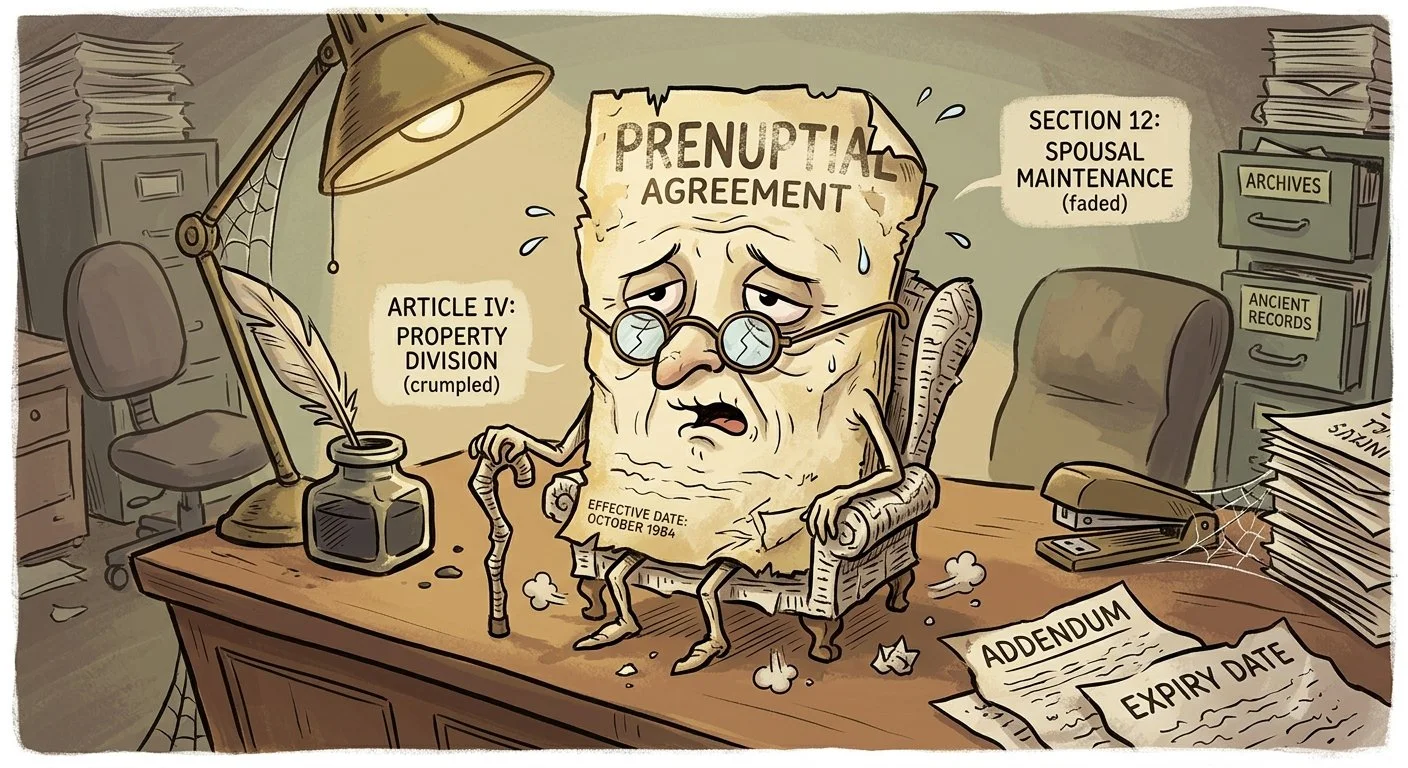
An old prenuptial agreement needs tending to. Don’t let your prenuptial agreement be voided due to lack of ongoing care.
Picture this: you sign a marriage agreement the day before your wedding, and it says your spouse's family money stays his. Then, years later, that same family money ends up paying for almost everything you own together.
When you separate, which one wins: the paper you signed, or the life you actually lived?
A new BC Supreme Court decision, Campbell v. Campbell, 2026 BCSC 1707, answers that question, and the answer should matter to anyone with a prenup, a large inheritance, or both.
The couple and the agreement
The parties began living together in March 2008. They married on June 26, 2010, and separated on June 21, 2021, which makes the relationship just over 13 years long. They have two young daughters.
Both worked in the finance industry when they met, and at the time of the wedding she actually earned more than he did.
On June 25, 2010, one day before the wedding, they signed a marriage agreement. It said:
Gifts and inheritances would stay the separate property of the person who received them.
She would earn a 7.5% interest in the family home for each year of marriage, up to 50%.
If the separation "trigger" came after their 15th anniversary, each would get 30% of the other's "shareable" property.
The trigger ended up being October 17, 2025, the date a judge declared there was no reasonable prospect they would reconcile. Because that date fell just after the 15th anniversary, the 30% clause applied.
Where the money came from, and where it went
In 2016 his mother passed away, and he inherited roughly $8 million, plus two recreational properties.
From 2018 to 2021, neither spouse worked, and the family lived on the inheritance. It paid for two homes in Ontario, a nanny, travel, and help for her family. She stayed home, went through years of fertility treatment, and raised the children.
By the time of trial, approximately $4 million remained.
Here was the problem. The "shareable" property listed in the agreement had essentially disappeared, and almost everything left could be traced back to his inheritance. Read strictly, the agreement would leave her with very little.
What each side asked for
He did not ask the court to enforce the agreement to the letter. Instead, he argued that the 30% figure should guide the split of everything, and he asked for 70/30 in his favour.
She asked for 60/40 in her favour, pointing to her lost career, her role as primary parent, and her lower earning power.
The judge ultimately gave her more than she asked for.
Why the prenup did not hold
This case was decided under BC's older law, the Family Relations Act. Under that law, a court can change the split if an equal division would be "unfair." The judge noted this is a lower bar than the "significantly unfair" test in today's Family Law Act.
Justice Burke used the framework from the Supreme Court of Canada's decision in Hartshorne v. Hartshorne. The key question is whether the agreement still operates fairly when the marriage ends.
She found that this one did not. It had never been reviewed as the family's circumstances changed, and the "shareable" property it was built around no longer existed.
She also made a sharp point about timing: an inheritance usually carries little weight when it arrived years before separation and was spent on family life, which is exactly what happened here.
Why the prenup still mattered
Here is the part many people miss: an agreement that operates unfairly is not simply thrown in the garbage.
The judge said both spouses were sophisticated professionals when they signed. The wife had a lawyer, and she signed freely. The parties' intentions at the start of the marriage "cannot be completely erased."
The judge also said choosing to stay home with children was something the parties could have foreseen. The hard fertility journey, however, likely was not.
So the judge landed in the middle, adjusting the division by 5% from an equal split: 55% to him and 45% to her.
Two money rulings worth knowing
He did not get credit for what he had already paid. He had paid about $230,000 to her since separation, and asked for that to be deducted. The judge refused, because those payments came out of capital that both spouses were sharing, and deducting them again would shrink her share twice.
Spending family money on family is not "dissipation." She argued he had disposed of about $780,000 in assets. The judge noted that much of that money funded support and her housing costs, which is not the same as hiding or wasting assets.
What this means for you
A prenup is a starting point, not a guarantee. If your life has changed significantly since you signed, the court will ask whether the agreement still operates fairly. If you want your prenup to hold, have it looked at after every major life change.
Review your agreement when life changes. A new child, an inheritance, or leaving a career are all good reasons to update it.
An inheritance is easiest to protect when it is kept separate. Once it pays for family homes and family life, its protective weight fades.
Good process still counts. Separate lawyers and a free signature helped the agreement keep some force, even here.
If you have a marriage agreement, or family money you want to protect, get advice before you separate, not after. Call me at 604-584-0007 to set up a free consultation.